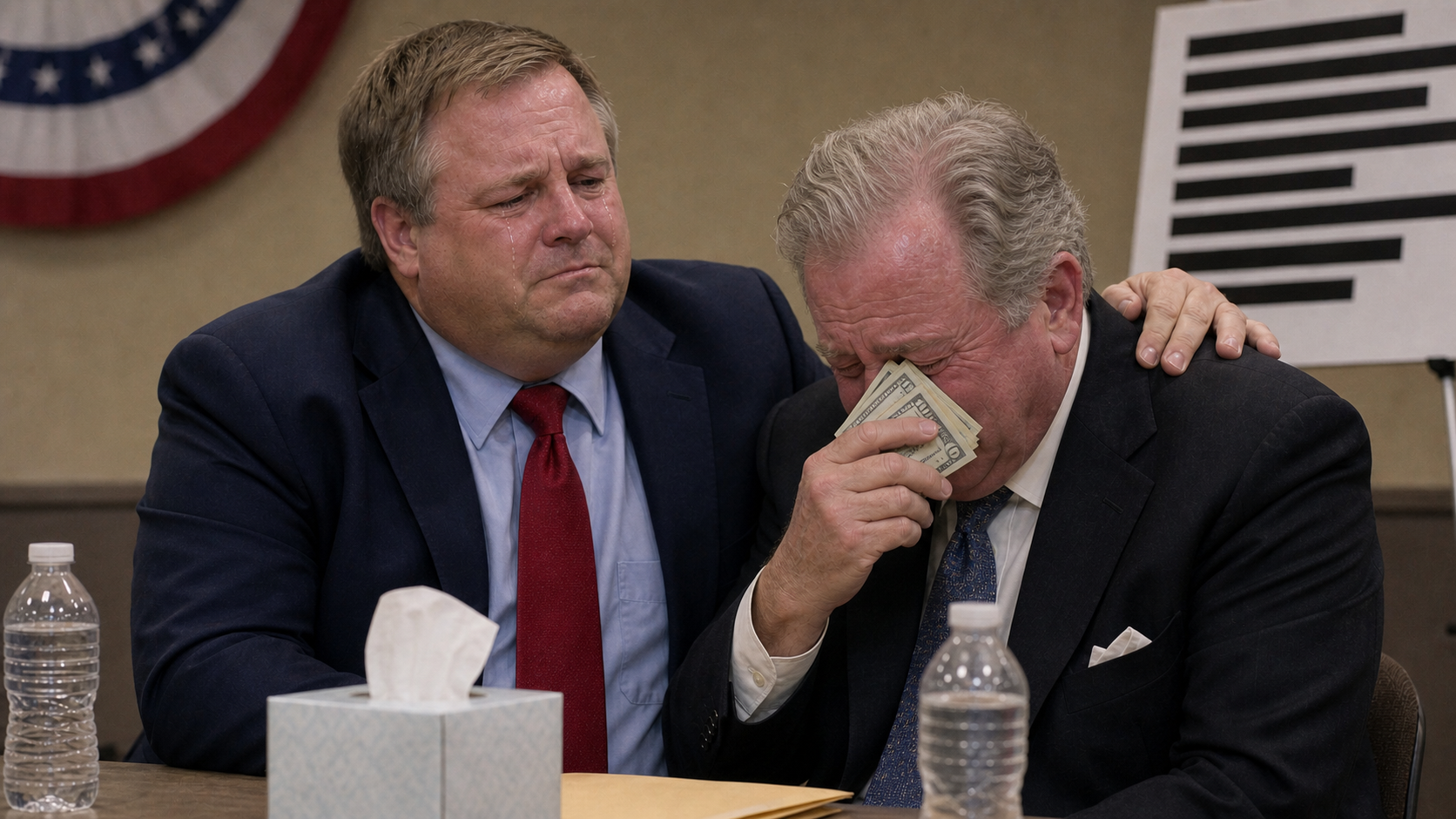
LITTLE ROCK, Ark. - Arkansas School Board candidate Randy McClintock hosted what his campaign called a “healing circle for document-impacted men” this week, offering comfort to several prominent Arkansans who said they had been harmed by “tone, implication, and the emotional violence of public context.”
The event began quietly, with McClintock asking attendees to bow their heads for “men whose names have been forced to appear near other words.” Several guests nodded along solemnly. One of them, financier Preston Kingswell III, appeared especially shaken.
Kingswell, who chairs multiple Fortune 500 companies, sat near the front with his hands folded, staring at the carpet whenever anyone said the word “records.”
McClintock, sensing pain in the room, placed a hand on Kingswell’s shoulder.
“This is a safe place,” McClintock said. “No one here is going to ask what page.”
For several minutes, Kingswell tried to compose himself. Then, after McClintock invited him to “share only what the documents have done to you,” he broke down.
According to Kingswell, his suffering reached a breaking point last Tuesday during a routine board meeting. The meeting had been proceeding normally, he said, until a boardwoman gave him what he described as “a dirty look.”
Kingswell later conceded that she did not mention the Epstein files or his name appearing in them.
“But you know,” Kingswell said. “Sometimes you know.”
“I saw it happen in her eyes,” Kingswell said, pressing a handkerchief to his face while McClintock held his shoulder. “She knew. She had recently been online. There was no warning. Just judgment.”
“I had prepared remarks on quarterly exposure,” Kingswell said. “I had not prepared to be looked at.”
McClintock, visibly moved, began crying beside him.
“I know that look,” McClintock sobbed.
McClintock said the gathering was inspired in part by reports that the Justice Department had treated men named in the Epstein files as possible victims when weighing redactions. Attendees said they understood the department’s reasoning, but were furious that the principle had apparently not been applied thoroughly enough to protect them.
“The justice system is finally catching up to what powerful men have always known,” McClintock said. “Visibility can be a form of harm.”
“For too long, people hear ‘Epstein files’ and think only about the girls,” McClintock said. “But there is another group of victims in those documents. Men with families. Men with reputations. Men with seats on compensation committees. Men who have had to live for years with the possibility that a woman in a meeting might know how to use Google.”
“For too long, victimhood has been limited to people something happened to,” McClintock said. “But what about a man something was written near? What about a man whose name is just sitting there, between other words, unable to explain itself?”
Kingswell told attendees he had endured “tone, implication, and people suddenly remembering calendars,” but nothing compared to the woman’s frown.
At that point, McClintock leaned closer, squeezed Kingswell’s shoulder, and began crying harder.
“No man should have to sit there while a woman silently judges him,” McClintock said.
McClintock said the incident reflects exactly why he is running for school board, arguing that Arkansas students are being raised in a dangerously “evidence-forward” environment.
McClintock said schools used to understand that certain matters required maturity, discretion, and a willingness not to make eye contact with a respected man after learning something troubling.
Several parents at the event questioned why a school board candidate was emotionally officiating a support group for rich men appearing in scandal documents. McClintock said the criticism proved his point.
“This is exactly the kind of judgmental culture I am running against,” he said. “One minute a man’s name is in a file, the next minute people are asking whether that file contains relevant information. Where does it end?”
At the close of the healing circle, a campaign aide passed around the event sign-in sheet and a black marker. Each attendee was invited to redact himself before leaving.
Kingswell took the marker and carefully blacked out his name, then the line beneath it, then part of the margin.
He looked up at McClintock.
“Is that enough?” Kingswell asked.
McClintock studied the page.
“It’s a start,” McClintock said.